Seal of confession
Exorcist FallsThe Seal of confession is the obligation that binds a priest to secrecy about what is disclosed in confession. In the novel, Father Sutherland’s adherence to it becomes a practical and moral crisis when the suspected Sweet Sixteen Killer seeks him out: Sutherland has information that could aid the investigation, but he believes his vows prevent him from simply giving it to the authorities. His partial disclosure does not resolve the dilemma. It makes the boundary visible, while leaving others to confront the danger on the far side of it.
The Obligation and Its Limits
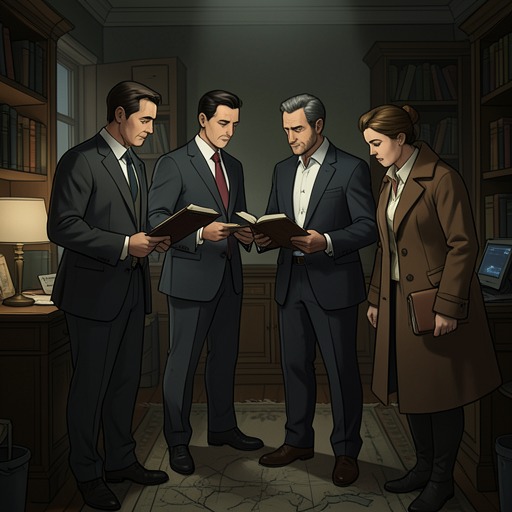
The rule is presented through Father Sutherland’s own account of his vows, not as a general legal explanation. He tells the assembled investigators that the killer visited his confession booth three days earlier. He then emphasizes that he is bound to maintain secrecy in such matters. The scene establishes the obligation as a serious constraint on what he can disclose, even when the information concerns a suspected murderer.
Sutherland does not treat the rule as a reason to say nothing whatsoever. Calling the case extraordinary, he offers a limited account of what the man in his booth told him: the confession included specific details not reported in the newspapers, including items the killer had taken from victims and hidden at home. The disclosure gives the investigation a meaningful lead, but it withholds the confessor’s identity. The distinction between describing incriminating knowledge and naming the person who revealed it is central to the scene.
The Sweet Sixteen Killer Investigation
The immediate pressure comes from the investigators’ suspicion of Jack Bittner. Father Sutherland rejects that suspicion and explains why: the killer had visited his booth. His statement sharply changes the room’s understanding of the case, but he does not convert the confession into an unrestricted source of evidence. Instead, the details he supplies point toward the actual killer without identifying him outright.
Danny Hartman asks why Sutherland did not go to the authorities. The question makes the practical cost of secrecy explicit. Sutherland answers that he did not know what to do. People look to him for guidance and wisdom, he says, but he is often as bewildered as they are; he can only ask God for guidance. His response neither claims certainty about the correct course nor disguises the consequence of his earlier silence. It portrays the rule as an obligation carried by a person who recognizes the stakes but does not possess an easy solution.
Ron Hartman reacts with anger, accusing Sutherland of keeping information to himself while girls were being impaled on meat hooks. Liz Hartman interrupts him. The exchange places the confessional obligation against the victims’ suffering and the family’s demand for an explanation. Sutherland’s limited disclosure answers part of the question—he did have contact with the killer—but cannot restore the time lost or satisfy the demand that he should have acted differently.
Secrecy, Judgment, and Other Decisions
The novel distinguishes the Seal of confession from other judgments made during the crisis. Father Sutherland later admits to Jason Crowder that he lied to the Hartmans about the outcome of earlier exorcisms because he believed the lie necessary to secure permission to perform one for Casey Hartman. That admission concerns obtaining the family’s consent, not keeping a confession secret. The contrast nevertheless clarifies the pressures surrounding Sutherland: his choices involve different obligations, and he does not present himself as infallible in deciding how to meet them.
Other scenes likewise present discretion as a separate matter. When Crowder is badly wounded, Father Patterson explains that he did not call an ambulance, questioning how the wounds could be explained. That decision is not described as an application of the Seal of confession. Keeping it distinct matters: the rule at issue here concerns what Father Sutherland may disclose about a confession, not every instance in which a priest withholds information or delays involving medical authorities.
Narrative Significance
The confession booth turns secrecy into a source of both knowledge and obstruction. The killer’s visit supplies Father Sutherland with unusually specific information, yet the very circumstance that gives the information weight also limits how he can pass it on. His compromise—revealing the stolen objects and their concealment without identifying the confessor—allows the case to move forward while preserving the conflict rather than neatly settling it.
Sutherland’s explanation also resists an uncomplicated portrait of priestly authority. The investigators expect him to know what to do; he admits that he was bewildered. His appeal to divine guidance expresses his faith, but it does not erase the human consequences of his decision. The Seal of confession therefore functions not only as a rule of secrecy but as a test of judgment under pressure: it protects a sacred confidence while placing the burden of uncertainty on the priest, the investigators, and the people endangered by the secret.